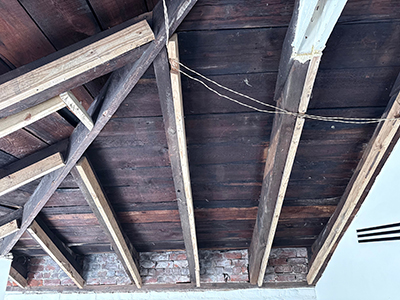
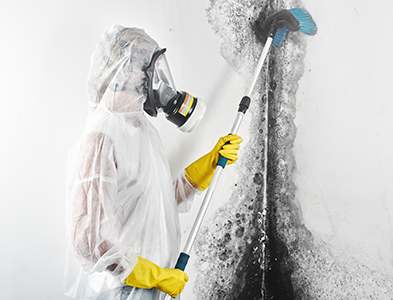
Mold targets porous, organic materials commonly used in modern construction. Cellulose-faced drywall is a primary food source. Mold eats through the paper backing, causing the gypsum core to crumble, sag, and structurally fail. Mold breakdown can eventually give way to wood-rotting fungi. This softens structural studs, joists, and subflooring, leading to warping or catastrophic collapse.
Ceiling tiles and carpets quickly absorb mold hyphae (root-like structures), making them impossible to clean and requiring complete replacement. As mold grows, it secretes metabolic byproducts, including acids and moisture. Mold destroys the glues holding composite woods together, causing plywood and Oriented Strand Board (OSB) to split and lose load-bearing capacity.
Mold grows beneath wallpaper and paint layers, breaking the bond with the wall and causing the finishes to bubble, crack, and peel away.
Mold growth easily migrates into hidden building systems, compounding the damage. Fiberglass and cellulose insulation trap mold spores and moisture. Once infested, the insulation clumps, loses its R-value (thermal resistance), and must be stripped out. Mold growing inside ductwork or on cooling coils restricts airflow, corrodes metal components, and turns the ventilation system into a distribution network for spores.
Even before structural failure occurs, mold ruins the usability and market value of a property. Mold leaves behind black, green, or yellow patches that permanently stain porous surfaces. The metabolic processes of mold release Volatile Organic Compounds (mVOCs), creating a persistent, musty smell that penetrates concrete and masonry.

Stopping moisture and radiant heat before they enter the building minimizes the workload on your cooling systems.
Use caulk and weatherstripping around windows, exterior doors, and plumbing penetrations. This prevents hot, humid outdoor air from infiltrating your conditioned space.
In crawlspaces or basements, lay down a heavy plastic vapor barrier to stop ground moisture from evaporating upward into your home's structural framing.
High-performance RB Shielding blocks radiant heat from radiating into your ceiling, keeping the attic cooler and preventing attic moisture from migrating into living spaces.
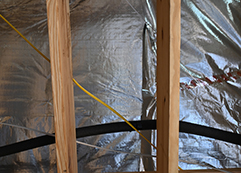
RB Shielding lowers humidity levels when installed properly. In high humidity areas, a perforated foil keeps the foil breathable, allowing rising indoor water vapor to pass completely through the foil and escape via roof vents while still reflecting heat.
RB Shielding also lowers radiant heat gain when installed with an air gap. Barrier laid flat against raw insulation or sandwiched between two solid materials without an air gap negates low-emissivity properties. Instead of reflecting heat, it conducts it, which increases temperatures and worsens humidity cycles.
RB Shielding works with the existing building envelope. In high-humidity areas, the attic must have functional soffit vents, ridge vents, or gable fans. The airflow sweeps away the moisture passing through your perforated barrier, keeping the attic dry and lowering the latent heat load.